
Resilience
Resilience is a central concept in ecology and biodiversity. The ability of ecological systems to resist, recover, and in some cases even benefit from disturbances is of integral importance in our ability to predict how biodiversity and its ecoservices may change in the future. However, the term resilience is often debated by ecologists (as well as many other peripheral disciplines). In the SalGo Team we are developing approaches to quantify and predict how ecological systems (from individuals, to populations, to whole communities) respond to disturbances. These approaches are primarily (but not uniquely) based on the examination of non-leading eigenvalues of structured systems, and in the combination of functional trait dimensions to predict fitness components.
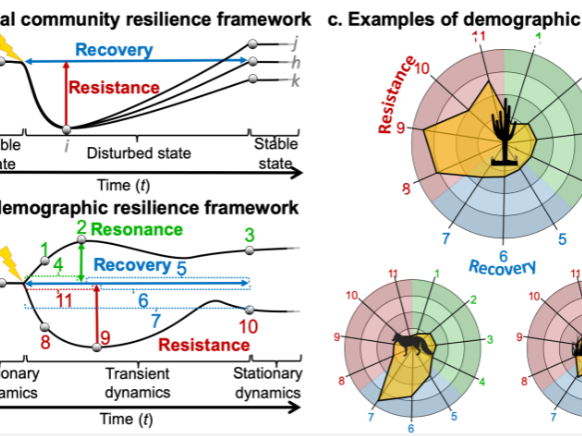
We are currently examining, based on a recent framework developed in the team, how the resilience ability of species varies as a fucntion of their proximity to urban settlements, the relative importance of recent vs. deep-time disturbances in species resilience and biodiversity, and the role of functional-traits in predicting transient vs. long term system responses to disturbances such as droughts and fires.
SalGo team members:
- Sarah Bull
- James Cant
- Chrissy Hernandez
- Jun Lee
- Thomas Merrien
- Rob Salguero-Gómez
- Rachael Thornley
- Man Qi
Selected collaborators:
- Maria Beger - Leeds University, UK
- Katrina Davis - Oxford Zoology
- Moreno DiMarco - Sapienza University, Italy
- Michelle Jackson - Oxford Zoology
- Dave Koons - Colorado State University, USA
- Iain Scott - Linconl University, UK
- Shripad Tuljapurkar - Stanford University, USA
Selected publications:
Jackson J, Middleton S, Lawson C, King H, Maseyk K, Hawes N, Salguero-Gómez R* & Hector A*. 2024. Experimental drought reduces the productivity and stability of a recovering calcareous grassland. Journal of Ecology 112, 917-931 DOI 10.1111/1365-2745.14282
Cant J, Capdevila P, Beger M, Salguero-Gómez R. 2023. Recent exposure to environmental stochasticity does not determine the resilience of natural populations. Ecology Letters 26, 1186-1199 DOI 10.1111/ele.14234
Cant J, Cook K, Reimer J, Mezaki T, Nakamura M, O'Flaherty C, Salguero-Gómez* & Beger M*. 2022. Transient amplification enhances the persistence of tropicalising coral populations in marignal high latitude environments. Ecography 10, e06156 DOI 10.1111/ecog.06156
Cant J, Salguero-Gómez R* & Beger M*. 2022. Transient demographic approaches can drastically expand the toolbox of coral reef science. Coral Reefs DOI: 10.1007/s00338-022-02250-x
Capdevila P, Stott I, Cant J, Beger M, Rowlands G, Grace M & Salguero-Gómez R. 2022. Life history mediates the trade-offs among different components of demographic resilience. Ecology Letters 25, 1566-1579 DOI 10.1111/ele.14004
Capdevila P, Stott I, Oliveras Menor I, Stouffer D, Raimundo R, White H, Barbour M & Salguero-Gómez R. 2021. Reconciling resilience across ecological systems, species, and subdisciplines. Journal of Ecology 109, 3102-3113 DOI 10.1111/1365-2745.13775
Capdevila P, Stott I, Beger M, Salguero-Gómez R. 2020. Towards a comparative framework of demographic resilience. Trends in Ecology and Evolution 35, 776-786 DOI 10.1016/j.tree.2020.05.001
Salguero-Gómez R. 2017. Applications of the fast-slow continuum & reproductive strategy framework of plant life histories. New Phytologist 4, 1618-1624 DOI 10.1111/nph.14289
Iles D, Salguero-Gómez R, Adler A & Koons D. 2016. Transient dynamics and life history explain biological invasion success. Journal of Ecology 104, 399-408 DOI 10.1111/1365-2745.12517
Salguero-Gómez R, Jones OR, Jongejans E, Blomberg S, Hodgson D, Mbeau Ache C, Zuidema PA, de Kroon H* & Buckley Y*. 2016. The fast-slow continuum and reproductive strategies structure plant life history variation worldwide. PNAS 113, 230-235 DOI 10.1073/pnas.1506215112
*Shared senior